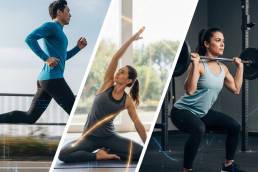
In 2025, “fitness content” is infrastructure.
It powers:
-
B2B health, wellness & fitness content studios & tech providers (SaaS / hardware)
-
Consumer fitness apps & digital platforms
-
Corporate wellness & employee wellbeing programs
-
Digital health & weight management solutions
-
Fitness studios & gym chains with digital offerings
-
Digital physiotherapy & rehab services
-
Independent coaches & personal trainers
-
Sports-specific & performance training systems
Across all of them, content is the product.
The macro picture:
-
Wearable technology is the #1 fitness trend for 2025, mobile exercise apps are #2, and data-driven training technology sits in the global top 10.
-
Health & fitness apps reached about 3.6B downloads in 2024, around 6% growth vs 2023.
-
In January 2025, users downloaded roughly 25.15M fitness & workout apps, with Strava alone close to 3.4M downloads worldwide.
-
In the UK, 83% of gym members train for physical fitness, 76% for mental wellness, and 68% for better sleep, especially among Gen Z.
This report answers the question that matters for your roadmap:
What did people actually train for in 2025—and what should you build in 2026?
We combine:
-
Independent research (ACSM, Statista, ukactive and others)
-
Anonymized 2025 data from the Hyperhuman platform
All Hyperhuman numbers below are actual platform percentages (Jan–Nov 2025), not estimates.
Methodology & Audience Focus
External sources
We used:
- ACSM 2025 Worldwide Fitness Trends – ranking wearables, mobile apps, older adults, weight loss, strength, HIIT, data-driven training, mental health and functional fitness in the global top 10. [Link]
- Statista – Health & Fitness Apps – 3.6B app downloads in 2024 (+6% YoY) and nearly 4B USD in in-app purchase revenues. [Link]
- Statista – Top Fitness & Sport Apps – January 2025 ranking, with Strava near 3.4M downloads and Mi Fitness around 3M. [Link 1] [Link 2]
- ukactive / UK gym data – member motivations: fitness, mental wellness, sleep. [Link]
Hyperhuman data
From the Hyperhuman “Fitness Content OS”, we analyzed:
-
Exercises – ownership, equipment, muscle groups, growth over the year
-
Workouts – category, duration, difficulty, equipment mix, shifts over time
-
Programs – goals, length, difficulty, category mix, equipment mix
-
Sessions – engagement & completion by category, duration, difficulty
-
Exports – by category, channel (file vs YouTube) and month
Audience

This Index is built primarily for:
-
B2B Fitness Content & Tech Providers (SaaS / Hardware)
-
Consumer Fitness Apps & Digital Platforms
-
Corporate Wellness & Employee Wellbeing Platforms
-
Digital Health & Weight Management Programs
-
Fitness Studios & Gym Chains with Digital Offerings
-
Digital Physiotherapy & Rehabilitation Services
-
Independent Fitness Coaches & Personal Trainers
-
Sports-Specific & Performance Training Solutions
Use it as your content benchmark when shaping 2026 product and GTM.
Download Report PDF Version
Insight 1 – When People Trained vs When Teams Created Content

Activity over the year
-
January: 20.0% of all sessions
-
Q1 (Jan–Mar): 36.4%
-
H1 (Jan–Jun): 64.1% vs 36.0% in H2 (Jul–Nov)
-
Secondary peaks in September (12.3%) and October (10.1%)
People start hard in January, then settle into steady usage with a strong autumn surge.
Library growth over the year
-
January: +110.6% vs Q1 baseline
-
July: +35.3%
-
February: −77.9%
-
May: −79.9%
-
August: −84.2%
Content creation happens in waves, often aligned with launches and big campaigns.
What this means for 2026
-
Design content sprints ahead of your clients’ peak periods (Q1, pre-summer, back-to-work).
-
Plan seasonal content drops around January and September/October, not just at New Year.
Insight 2 – How Your Exercise Library Actually Looks

Original (incl. AI Generated) vs stock
| Exercise Type | Share of Library |
|---|---|
| Original / non-stock | 88.3% |
| Stock (customized) | 11.7% |
Teams rely on stock as a booster, but the backbone is owned content (incl. AI Generated with CloneMotion™)—critical for B2B providers selling IP and brands.
Bodyweight vs equipment
| Exercise Equipment Type | Share of Exercises |
|---|---|
| Bodyweight | 61.5% |
| Free weights | 23.0% |
| Gym equipment | 15.5% |
Even with hardware in the mix, the exercise-level library is firmly bodyweight-first.
Muscle group focus
Share of exercises by primary muscle group:
| Muscle Group | Share of Exercises |
|---|---|
| Legs | 23.1% |
| Core | 19.3% |
| Glutes | 16.1% |
| Arms | 9.5% |
| Shoulders | 8.5% |
| Back | 8.0% |
| Warm-up | 7.8% |
| Chest | 4.2% |
| Cool-down | 3.5% |
Lower body, core & glutes dominate, with meaningful warm-up and cool-down coverage baked in.
For 2026
-
Ship libraries that are bodyweight-capable by default, then layer equipment variants.
-
Ensure enough back, posture, warm-up and cool-down content to match pain and ergonomics use cases.
Insight 3 – How Workouts Are Structured: Categories, Duration, Difficulty

Workout categories mix
| Workout Category | Share of Workouts |
|---|---|
| Strength | 27.5% |
| Endurance | 15.1% |
| Other | 12.0% |
| Mobility | 9.7% |
| Cardio | 9.2% |
| HIIT | 7.8% |
| Balance | 7.6% |
| Pilates | 6.5% |
| Yoga | 3.0% |
| Physiotherapy | 0.5% |
| Sport Mastery | 0.4% |
| Tabata | 0.2% |
| Recently Introduced: Mind–Body / Pregnancy & Postpartum / Recovery / Corrective Exercise / Guided Run | ≤0.1% each |
The backbone of most libraries is:
Strength + Endurance + Mobility + Cardio, with HIIT, Balance and Pilates as strong supporting roles.
Workout duration preferences
| Duration Bucket | Share of Workouts |
|---|---|
| Short (< 15 min) | 38.3% |
| Medium (15–45 min) | 42.2% |
| Long (> 45 min) | 19.4% |
Most workouts are designed to be short or medium, with longer sessions a smaller but important specialty.
Workout difficulty mix
| Difficulty Level | Share of Workouts |
|---|---|
| Beginner | 49.7% |
| Intermediate | 32.3% |
| Advanced | 18.1% |
Half of all workouts are Beginner-friendly, which pairs nicely with Intermediate-first programs (see below).
Equipment mix at workout level
| Workout Equipment Profile | Share of Workouts |
|---|---|
| Free weights | 51.1% |
| Mixed equipment | 24.8% |
| Bodyweight-only | 21.1% |
| Gym equipment-only | 3.0% |
The workout-level ecosystem is equipment-friendly, but 1 in 5 workouts remain fully bodyweight.
For 2026
-
Structure catalogs around category + duration + difficulty that match these distributions.
-
Double down on short & medium Strength / Endurance / Mobility / Cardio as your core.
Insight 4 – How Programs Are Designed: Goals, Length, Difficulty & Mix

What goals programs target
Share of programs by goal:
| Program Goal | Share of Programs |
|---|---|
| Improve endurance | 25.9% |
| Lose weight | 25.6% |
| Build strength | 23.7% |
| Get toned | 21.8% |
| Increase mobility | 15.1% |
| Physiotherapy | 2.2% |
| Build Skills & Performance | 0.3% |
Most programs are built around a “big four”:
Endurance, Weight Loss, Strength, Toning, with Mobility close behind.
Program length preferences
| Program Length | Share of Programs |
|---|---|
| > 8 weeks | 91.8% |
| 5–8 weeks | 4.1% |
| 1–2 weeks | 2.2% |
| 3–4 weeks | 1.9% |
Despite the hype around “14-day challenges”, multi-month programs are the norm.
Program difficulty profile
| Program Difficulty | Share of Programs |
|---|---|
| Intermediate | 43.8% |
| Beginner | 35.3% |
| Advanced | 20.8% |
Programs lean Intermediate-first, while workouts lean Beginner-first—exactly what you want as clients progress.
How goals are built under the hood
Build strength programs – Category mix
| Category | Share of Workouts in Goal |
|---|---|
| Strength | 35.8% |
| Mobility | 14.1% |
| Balance | 13.6% |
| HIIT | 10.1% |
| Pilates | 9.5% |
| Endurance | 8.3% |
| Cardio | 5.8% |
Build strength programs – Equipment mix
| Equipment Type | Share of Workouts |
|---|---|
| Bodyweight | 63.5% |
| Free weights | 33.5% |
| Gym equipment | 3.0% |
Lose weight programs – Category mix
| Category | Share of Workouts in Goal |
|---|---|
| Strength | 22.6% |
| HIIT | 18.2% |
| Cardio | 16.7% |
| Mobility | 15.8% |
| Endurance | 15.2% |
| Balance | 6.9% |
Lose weight programs – Equipment mix
| Equipment Type | Share of Workouts |
|---|---|
| Bodyweight | 71.0% |
| Free weights | 25.7% |
| Gym equipment | 3.2% |
Increase mobility programs – Category mix
| Category | Share of Workouts in Goal |
|---|---|
| Mobility | 44.3% |
| Balance | 22.6% |
| Pilates | 12.6% |
| Strength | 6.6% |
Physiotherapy programs – Category mix
| Category | Share of Workouts in Goal |
|---|---|
| Cardio | 18.7% |
| Balance | 18.7% |
| HIIT | 16.8% |
| Pilates | 15.9% |
| Mobility | 13.1% |
| Strength | 12.1% |
Physiotherapy programs – Equipment mix
| Equipment Type | Share of Workouts |
|---|---|
| Bodyweight | 83.3% |
| Free weights | 15.6% |
| Gym equipment | 1.1% |
Key pattern:
Every serious goal is multi-modal and bodyweight-heavy, even when the story is “strength”, “weight loss” or “performance”.
Insight 5 – What Users Actually Completed (Sessions & Behavior)

Engagement by category
Share of completed sessions:
| Workout Category | Share of Completed Sessions |
|---|---|
| Strength | 29.3% |
| Endurance | 15.4% |
| Mobility | 12.2% |
| Cardio | 9.6% |
| Pilates | 8.3% |
| Balance | 7.9% |
| Other | 6.7% |
| HIIT | 5.7% |
| Yoga | 2.9% |
| Tabata | 0.9% |
| Sport Mastery | 0.7% |
| Physiotherapy | 0.5% |
Completion rate by category:
| Workout Category | Completion Rate |
|---|---|
| Tabata | 62.5% |
| HIIT | 54.1% |
| Mobility | 49.5% |
| Strength | 49.3% |
| Cardio | 44.8% |
| Pilates | 41.7% |
| Physiotherapy | 38.5% |
| Balance | 36.1% |
| Yoga | 28.9% |
| Other | 24.4% |
Strength, Endurance and Mobility account for 57%+ of all completed sessions, while focused formats (Tabata, HIIT, Strength, Mobility) drive the highest completion.
Duration: mix vs completion
| Duration Bucket | Share of Workouts | Completion Rate |
|---|---|---|
| Short (< 15 min) | 38.3% | 41.2% |
| Medium (15–45 min) | 42.2% | 45.9% |
| Long (> 45 min) | 19.4% | 34.6% |
Medium-length sessions are the sweet spot for completion; long workouts lag by >11 points.
Difficulty: mix vs completion
| Difficulty Level | Share of Workouts | Completion Rate |
|---|---|---|
| Beginner | 49.7% | 39.5% |
| Intermediate | 32.3% | 44.3% |
| Advanced | 18.1% | 54.0% |
Advanced users are fewer, but they finish more of what they start.
Actual vs planned time
| Difficulty Level | Avg % of Planned Time Completed |
|---|---|
| Beginner | 22.9% |
| Intermediate | 24.8% |
| Advanced | 21.3% |
Even when users “complete” a workout structurally, they often don’t consume the full planned duration.
Insight 6 – What Gets Exported and Promoted

Category shift from H1 2025 to H2 2025
| Category | H1 Share | H2 Share | Change (points) |
|---|---|---|---|
| Mobility | 8.8% | 14.5% | +5.7 |
| Pilates | 5.4% | 10.4% | +5.0 |
| Cardio | 9.8% | 12.0% | +2.2 |
| Balance | 8.2% | 9.9% | +1.7 |
| Other | 18.6% | 8.6% | −10.0 |
| Endurance | 21.4% | 13.3% | −8.1 |
| Strength | 34.4% | 29.6% | −4.8 |
| Yoga | 4.6% | 2.2% | −2.4 |
As 2025 progressed, teams shifted production towards Mobility, Pilates, Cardio and Balance, while Strength and Endurance remained strong but less dominant.
Exports by category
Share of exports by workout category:
| Workout Category | Share of Exports |
|---|---|
| Strength | 26.4% |
| Other | 15.5% |
| Endurance | 14.2% |
| HIIT | 10.1% |
| Mobility | 9.6% |
| Cardio | 7.2% |
| Balance | 6.4% |
| Yoga | 4.6% |
| Pilates | 4.4% |
| Tabata | 1.0% |
| Physiotherapy | 0.4% |
| Sport Mastery | 0.2% |
Exports (to file / social / public channels) are heavily Strength- and Endurance-led, with Mobility and Cardio also featuring strongly.
Export timing
-
File exports (full workouts): March (16.8%), April (16.4%) and August (18.6%) together = 51.8% of all file exports.
-
YouTube exports: January (27.5%) and July (16.5%) together = 44.0% of all YouTube exports.
Teams cluster export activity around major campaigns and seasons.
How to Use This Index in 2026

1. B2B Fitness Content & Tech Providers (SaaS / Hardware)
-
Treat this report as your content spec for category, duration, difficulty and goals.
-
Bundle your platform/device with ready-to-use libraries and programs that mirror these distributions.
-
Use Hyperhuman as your white-label content OS to generate, manage and deliver video workouts via API.

2. Consumer Fitness Apps & Digital Platforms
-
Design navigation around goals + category + duration + difficulty.
-
Default to 15–45 minute Strength / Endurance / Mobility sessions, with short options for streaks.
-
Use bodyweight-first variants to support home, travel and low-equipment use.

3. Corporate Wellness & Employee Wellbeing Platforms
-
Match real motivations: fitness, mental wellness, sleep, posture & pain.
-
Offer short, focused sessions that fit between meetings.
-
Deliver content inside existing tools via API & embeds, not just yet another app.

4. Digital Health & Weight Management Programs
-
Build journeys that reflect real weight loss & toning composition: Strength + HIIT + Cardio + Mobility, mostly bodyweight.
-
Combine content with coaching, nutrition and biometrics for outcome-focused personalization.
-
Use long programs (>8 weeks) as your structural spine.

5. Fitness Studios & Gym Chains with Digital Offerings
-
Align on-demand libraries with the core category and difficulty mix.
-
Extend in-club experiences with travel-friendly, bodyweight-first programs.
-
Time exports around member campaigns (New Year, pre-summer, back-to-work).

6. Digital Physiotherapy & Rehabilitation Services
-
Mirror physiotherapy patterns: Bodyweight + Mobility + Balance + Pilates + low-impact Cardio.
-
Build structured journeys for pain, function, return-to-work and return-to-sport.

7. Independent Fitness Coaches & Personal Trainers
-
Package expertise into multi-month programs around the big goals: strength, weight loss, toning, endurance.
-
Use Hyperhuman to handle production, payments and export, so you focus on coaching and sales.

8. Sports-Specific & Performance Training Solutions
-
Build performance programs with Strength + Mobility + Balance + HIIT + Recovery, then layer sport skills.
-
Use short/medium sessions in-season; long sessions off-season.
How Hyperhuman Fits into Your 2026 Plan
This 2025 State of Fitness & Wellness Content is your map.
Hyperhuman is the engine that lets you execute on it.
With Hyperhuman, you can:
-
Benchmark
-
Measure your current library, programs and engagement against these real-world distributions.
-
-
Build
-
Use AI and your own footage to generate goal-based, multi-modal, bodyweight-first or equipment-rich content at scale.
-
-
Deliver
-
Export structured workouts as full videos, social clips and API payloads to apps, portals, platforms and devices—under your brand.
-
As part of our End of 2025 Content Report campaign:
All first-time purchases—monthly or yearly—get an extra 10% off with the code: HYPERREPORT25
If you’re planning your 2026 roadmap, this is the moment to lock in your Fitness Content OS:
In 2026, don’t just follow content trends.
Define them.